
From GPS to Physical AI: The Next Revolution in Agriculture
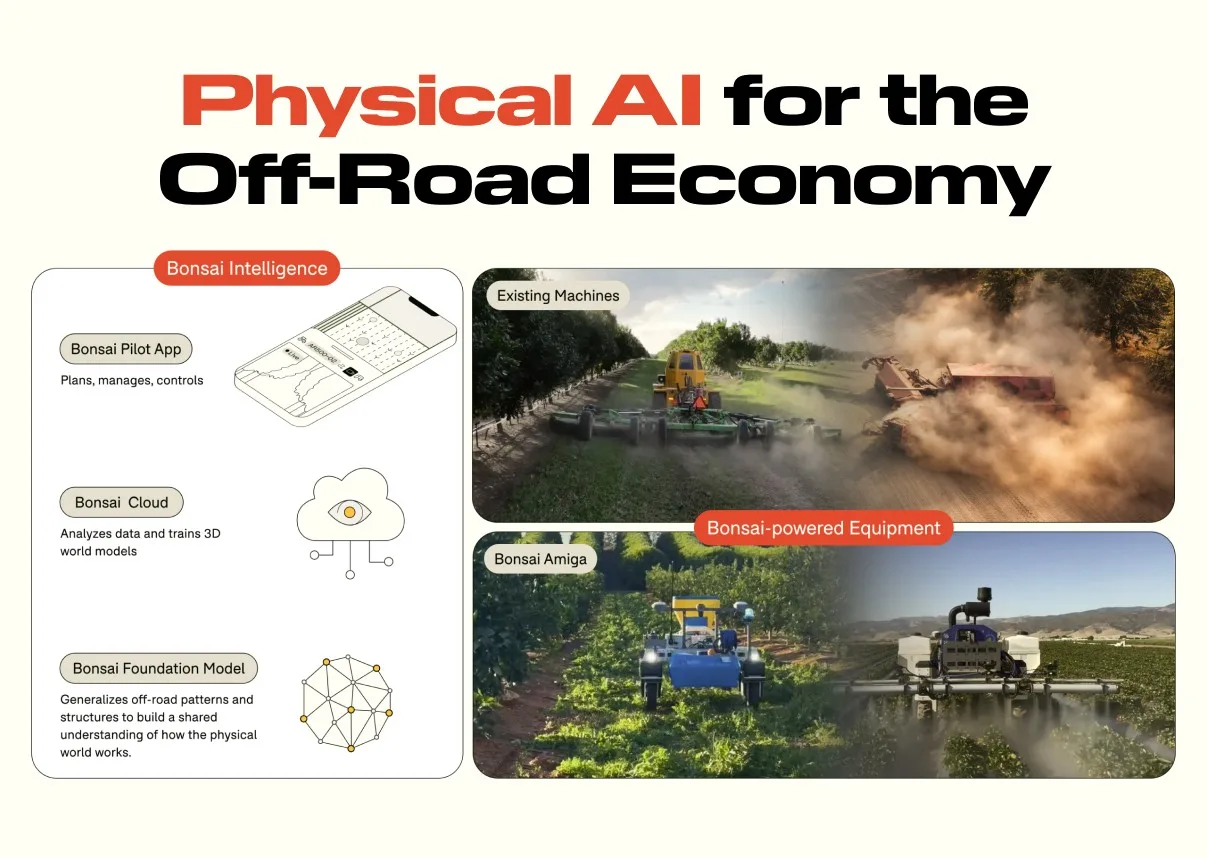
I’ve spent my entire career at the intersection of agriculture and technology. I grew up in the Midwest, my wife’s family has farmed in Iowa for three generations, and we still own farmland there today. I ran tractor programs at John Deere. I later was the Director of Technology and helped bring deep learning-powered computer vision into commercial agriculture through the Blue River Technology acquisition. I’ve watched decades of promising ag tech arrive with fanfare and fall short of its promise. I’ve also had a front-row seat to three of the most important technology transitions in modern agriculture: precision guidance, digital agriculture, and AI-powered computer vision. Each fundamentally changed how machines operate and how farmers make decisions. Today, I believe we’re witnessing the beginning of a fourth transformation, one that may ultimately prove larger than all three.
So when I say we’re at a genuine inflection point, I’m not making a pitch. I’m making an observation that’s taken thirty years of context to arrive at.
GPS Was Never Autonomy
How the industry conflated navigation with intelligence and why it mattered
For the past thirty-plus years, the agricultural industry has had what’s commonly called auto-guidance: GPS-enabled steering that keeps a tractor on a straight line across a field. A lot of people, farmers, journalists, industry analysts, have described this as autonomous.
It isn’t. Not even close.
Auto-guidance follows a GPS path. That’s it. There is no perception stack. The machine has no awareness of the physical world around it. It cannot identify an obstacle, respond to a change in conditions, or make any kind of decision. It’s closer to cruise control than autonomy.
The distinction matters because it explains why our ambitions kept outrunning the technology. Farmers and ag companies wanted true autonomy, machines that could perceive, decide, and act, for decades to come. But the foundational technology to deliver it simply wasn’t there:
- Edge compute wasn’t powerful enough to run advanced models on the machine itself
- High-bandwidth, low-latency connectivity didn’t exist in the remote rural environments where most agriculture happens
- Deep learning and modern model development hadn’t yet matured
- Simulation tools and synthetic data pipelines were primitive compared to what’s available today
The aspiration was always right. The technology just wasn’t ready.
What Finally Changed
The convergence of compute, connectivity, and AI that makes real autonomy possible
The shift didn’t happen because of any single breakthrough. It happened because several technologies matured at the same time and their combination crossed a threshold:
- Edge compute: We can now run the world’s most advanced AI models directly on the machine, in the field, in real time. That wasn’t possible five years ago.
- Connectivity: Starlink and other low-earth-orbit satellite systems and other terrestrial technologies have brought high-bandwidth connectivity to the remote corners of the world where agriculture operates. Data can now flow as easily to and from a machine in an Australian orchard or an Iowa cornfield and the cloud as it does in urban areas.
- Deep learning and model development: The advances in neural network architectures and training methods that drove the AI revolution in language and vision have now been applied to physical AI and robotics with profound results.
- Simulation and synthetic data: We can now build photorealistic 3D worlds in a lab and use them to train and test models at a scale and speed that real-world data collection alone could never support.
- Robotics and control systems: The hardware and control systems needed to translate model outputs into precise machine actions have become more capable, more reliable, and more cost-effective.
What makes this moment particularly significant is the emergence of AI foundation models. Just as large language models transformed how computers understand and generate language, foundation models for robotics are beginning to help machines understand and reason about the physical world.
Traditional automation relied on engineers manually defining rules for every situation a machine might encounter. Foundation models learn representations of the world itself, allowing machines to adapt to changing conditions and environments that were never explicitly programmed. That shift is fundamental.
None of these individually would have been enough. Together, they finally closed the gap between what the industry wanted and what was technically possible.
We’ve finally reached the inflection point where the technology has caught up with our dreams and our aspirations. And now we can actually go do this in a way we’ve never been able to before.
The Data Flywheel That Makes It Compound
Why Bonsai Robotics early deployment strategy created an advantage that only grows over time
Understanding why we’re at an inflection point is one thing. Understanding why Bonsai Robotics is positioned to lead from it is another, and it comes down to data.
We’ve been deploying autonomous machines in real commercial farm environments for years. Today, that represents over one million acres of real-world operational data, collected across diverse crop types, geographies, lighting conditions, and machine form factors. That data set is not available for purchase. It was built through deployment, one season at a time.
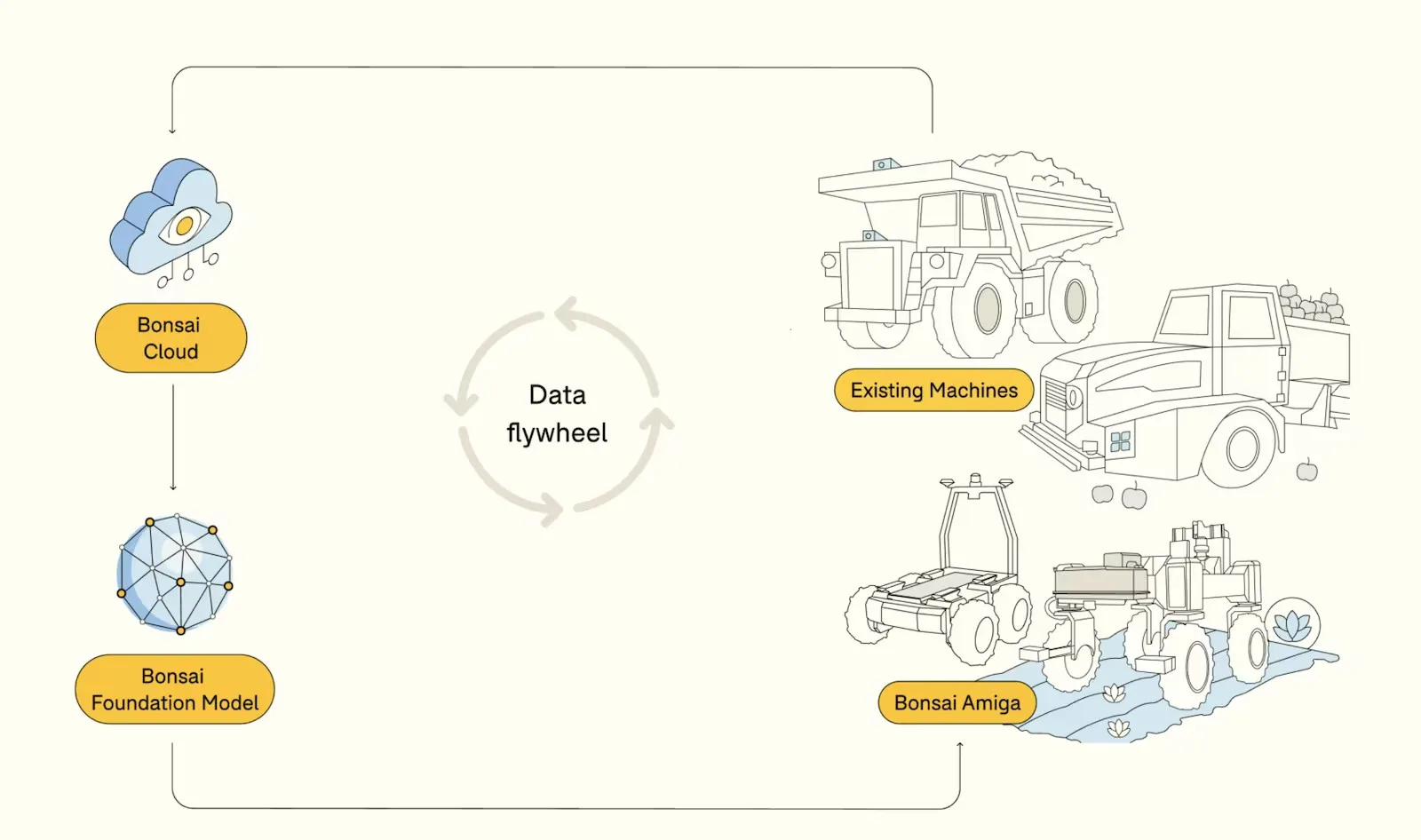
The flywheel works like this:
- Real-world deployments generate diverse, high-quality training data
- That data trains better models, both vision-based and 3D perception models
- Better models enable more deployments, in more environments, on more machine types
- More deployments generate more data, and the cycle accelerates
This is paired with a robust simulation capability. We build synthetic 3D environments in the lab to generate additional training data and test model performance, allowing us to iterate far faster than real-world seasonal data collection alone would permit. Real-world data and synthetic data together produce a model that is genuinely generalizable: one that can navigate safely in any outdoor, off-road environment without being retrained for each new crop, geography, or machine.
The result is a single foundational model that understands topography, identifies obstacles, and controls machines safely, whether it’s an almond shaker in Fresno, a tractor in a Midwest cornfield, or an implement in a vineyard.
At Bonsai Robotics, we often describe this as building a world model. The machine isn’t simply identifying objects or following a route. It’s continuously developing an understanding of topography, obstacles, equipment, crops, and people around it. The better that understanding becomes, the more capable, reliable, and generalizable autonomy becomes.
In many ways, the future of autonomy is not about better GPS. It’s about building machines that understand the world around them.
Why This Time Is Different From Every Other Wave of Hype
The proof is in commercial deployment, not in a demo
Agriculture has seen a lot of technology cycles. GPS guidance. Precision ag. Variable rate application. Each one arrived with enormous promise. Each one delivered real value but rarely at the scale or speed the industry hoped.
The current moment feels different for several reasons:
- It’s already working commercially: Our autonomous shaker, built in partnership with OMC, operates faster, more fuel-efficiently, and more safely than a human operator, not in a test environment, but in real commercial harvests
- The performance gap is real: Autonomous operation isn’t just comparable to human performance in these applications. In measurable ways, it’s better. Faster cycle times, lower fuel consumption, consistent execution, and no operator fatigue
- The data advantage compounds: Unlike previous technology waves where every new entrant could start from the same baseline, the data flywheel creates a compounding advantage that grows harder to replicate over time
- The economics now make sense: Input costs, labor costs, and land values are all putting pressure on farm margins at exactly the moment that autonomous technology has become commercially viable
One prediction I feel increasingly confident making is that off-road autonomy will achieve broad commercial adoption before autonomous passenger vehicles. Agriculture, mining, construction, and other outdoor industries operate in structured environments where the economic incentives are immediate and compelling. The result is that some of the most important advances in physical AI may occur first in fields, orchards, and work sites rather than on city streets.
The farmers adopting this technology aren’t early adopters taking a risk on an unproven concept. They’re practical businesspeople responding to a changed economic reality with the best tool available.
What This Means for the Future of Farming
From walking beans to physical AI and what comes next
I spent summers as a teenager walking soybean fields in Iowa, pulling weeds by hand across hundreds of acres in the humid Midwest heat. It was exhausting, physical, repetitive work. Then Roundup Ready soybeans (and glyphosate) arrived and within a few seasons, walking beans – a rite of passage for generations of farm kids across the Midwest – was over. Gone. An entire category of agricultural labor didn’t gradually decline; it was effectively engineered out of the system by superior technology.
What’s coming now is bigger.
The machines of the future won’t be designed around human operators. They’ll be purpose-built from first principles for autonomous operation, smaller, lighter, more energy-efficient, capable of caring for individual plants rather than designed to maximize acres covered per hour via more horsepower, wider working widths, and faster speeds. The economics of farming will shift as operating costs fall, labor dependency shrinks, and machines deliver a level of precision, productivity and consistency no human crew can match.
For farmers, especially the ones already applying every technology available and still operating on razor-thin margins, this isn’t an abstraction. It’s survival. The technologies we’re developing at Bonsai are what will allow the next generation of farmers to continue farming: to take their family’s legacy forward, to remain viable in an industry where the margins keep tightening.
For the last thirty years, agriculture has been digitizing information. Over the next thirty years, agriculture will increasingly digitize labor.
The winners in that future won’t simply build better machines. They’ll build machines that can perceive, understand, and act within the physical world around them. That’s the promise of physical AI, and for the first time, the underlying technology is finally ready.
The technology caught up. Now the challenge is deploying it at scale and ensuring farmers everywhere can benefit from it.
John Teeple, COO of Bonsai Robotics