
Why Investing in the Next Generation of Agricultural Innovators Matters
Building the Workforce Behind the Future of Farming
At Bonsai, we believe solving agriculture’s toughest challenges is not just about technology, it’s about empowering the next generation of talent to wield this technology to address the most pressing issues that growers face.
Feeding the world with fewer resources — less labor, less water, and less margin for error — is one of the defining challenges of our time. Solving it requires people with the skills and vision to apply robotics and AI in one of the most complex environments there is: agriculture.
That’s why Bonsai has been proud to be a part of the Farm Robotics Challenge since its inception four years ago. This year’s competition — 96 teams, 13 countries, more than $100,000 in prizes — brought practical, durable projects to life that growers could actually adopt. These aren’t students building for a classroom, they’re building for a field.
At Bonsai, we believe solving agriculture’s toughest challenges requires both breakthrough technology and the next generation of innovators. By making robotics and autonomy accessible through our platform, we empower students to apply AI and robotics to real-world farming challenges. This year, half of the winning entries were built on the Amiga platform.
Growers today face unprecedented pressures: labor shortages, water constraints, rising production costs, and increasing demands for efficiency and sustainability. Meeting these challenges will require talented individuals who understand both advanced technology and the realities of farming operations.
That’s why Bonsai has proudly supported the Farm Robotics Challenge since its inception four years ago. The 2026 competition brought together 96 teams, participants from 13 countries, and more than $100,000 in prize funding.
Most importantly, it showcased practical solutions designed for the field, not the classroom demonstrations.
What Stood Out in This Year’s Competition
Solutions Built for Growers, Not Just Judges
The 24 teams that competed for the Amiga Innovation Awards tackled problems that matter to growers right now: disease detection, weed management, precision spraying, labor reduction. What struck our judges wasn’t just the technical sophistication. It was the clarity of purpose.
Every winning project had a clear answer to the question growers actually ask: will this work on my farm, and is it worth it?
Division I Winner: Tackling Fire Blight with Precision Robotics
Amiga Innovation Award $10,000 prize — Carnegie Mellon University
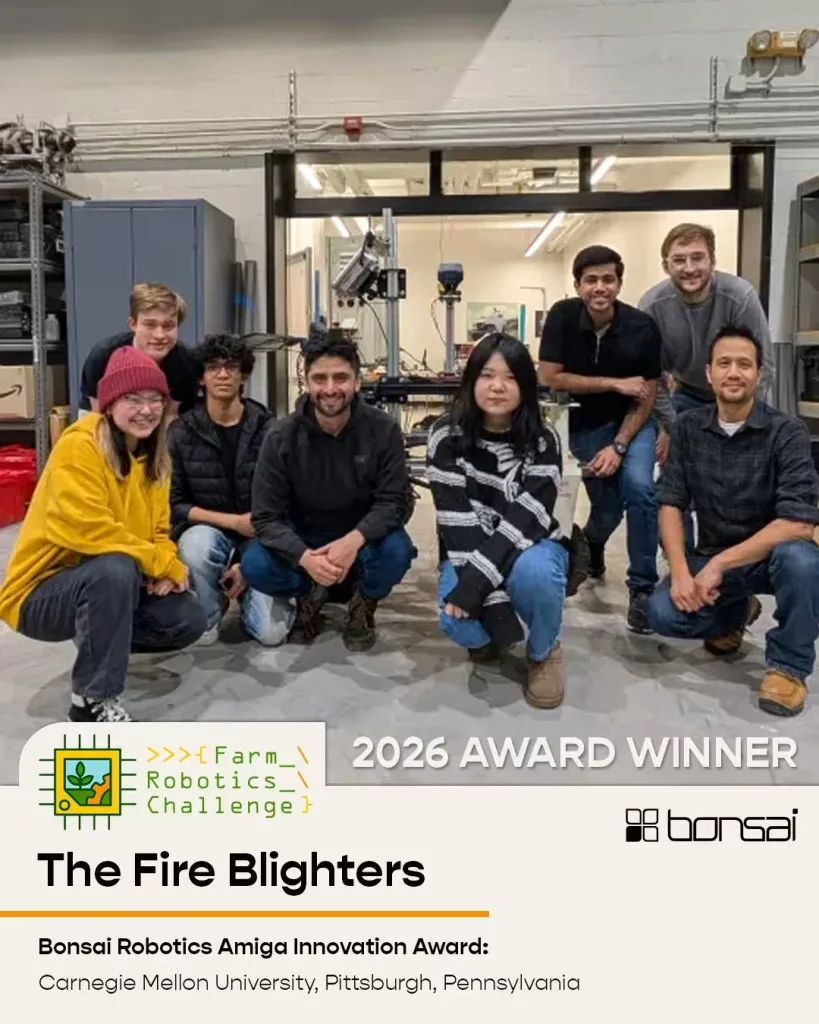
Fire blight remains one of the most economically damaging diseases affecting apple production. Carnegie Mellon’s Fire Blighters team developed a comprehensive robotic solution on the Amiga platform that impressed judges with both its technical execution and practical application.
Key capabilities included:
- An articulating camera system capable of viewing canopy areas hidden from fixed sensors
- Enhanced data collection from occluded sections of trees
- LiDAR-based localization for precise navigation
- A six-degree-of-freedom robotic arm
- Automated detection and mapping of infected trees
- Physical marking of diseased trees to support targeted pruning
- A grower-friendly visual interface for monitoring findings
The result was a highly integrated system that could realistically be deployed and managed in a commercial orchard. Watch the video.
Division II Winner: Practical Innovation from the Central Valley
Amiga Innovation Award $5,000 prize — Reedley College
Team Tiger Ag-Botics from Reedley College demonstrated that impactful agricultural innovation doesn’t require a major research university. Located in California’s Central Valley and surrounded by vineyards, the Tiger Ag-Botics team developed a solution grounded in the needs of local growers.
Their Amiga project featured:
- A solar-powered autonomous sprayer
- Variable-rate application technology
- Autonomous route-following capabilities
- Follow-me functionality for operator assistance
- Rapid development and deployment
The project stood out for its practicality, simplicity, and readiness for real-world use. Watch the video.
Academy Division Winner: High School Students Deliver Commercial Potential
Amiga Innovation Award $1,000 prize — Mark Richardson CTE Center & Agricultural Farm
Team MRC Farm Robotics from Santa Maria, California demonstrated that agricultural innovation can begin well before college.
The team created a foliar-feeding robot built on the Amiga platform that focused on helping small vegetable growers improve efficiency.
Their Amiga solution included:
- Integration of commercially available components
- Precision foliar application capabilities
- Reduced labor requirements
- User-friendly operation
- A design focused on practical adoption
Perhaps most impressive was the team’s focus on creating a solution that addressed genuine grower needs while remaining accessible to operators without advanced robotics expertise. Watch the video.
Grand Prize Winner: A Startup in the Making
$50,000 SAFE Investment, sponsored by Reservoir – Cornell University
The top prize went to a team that didn’t just build something impressive — they built something that’s already heading toward the market. Team Rootline Robotics from Cornell developed an autonomous robotic weeder for orchards and vineyards that delivers pulsed high-voltage microshocks to eliminate weeds, mounted as an arm attachment on the Amiga.
The system combines computer vision, machine learning and depth sensing with a mechanical arm and electrode array that conditions plant geometry before treatment, all validated with a real grower partner, Crist Bros Orchards, a 500-acre commercial apple operation in New York.
They’re now advancing commercialization through Cornell’s Center for Technology Licensing, the Rev: Ithaca Startup Works Hardware Accelerator, and continued field validation this summer. Bonsai will add $25,000 in Amiga hardware and Bonsai autonomy upon incorporation. Watch the video.
What This Means for the Future of Agriculture
Real-World Experience Creates Better Innovators
We started supporting the Farm Robotics Challenge because we believed the next wave of agtech talent needed a different kind of training ground, one where the measure of success isn’t a grade, but whether a grower would actually use it.
Four years in, that bet looks right. The students coming through this program think differently than a typical engineering graduate. They’ve wrestled with the economics of specialty crops, the frustration of sensors that fail in dusty conditions, the challenge of building something a farmer trusts enough to run unsupervised.
That’s not something you learn in a lab. And it’s the exact capability that will determine who wins in agricultural automation over the next decade.
We’re proud to invest in it — and we can’t wait to see what these teams build next.
Interested in competing in the 2027 Farm Robotics Challenge?
- Build your project on the new Amiga Flex! We’re offering a 20% discount to educational institutions plus a free one-year subscription of Bonsai Intelligence, our autonomy stack. Learn more and apply.
- Registration for the Challenge opens on August 3, 2026. Get updates and learn more here.